Note: I have not
read the manga. My praise or criticisms
could very well be modified by future information, but for now I write on what
I have experienced. Also stole a few
screenshots from S2.
Attack on Titan is a series that requires no introduction;
like or hate it, it is one of the most spectacularly successful anime to ever
be released. As such it is subjected to
constant criticism and pointed hatred.
The process that contemporary popular series go through in the anime
community is so reliable that I facetiously suggest that there must be predetermined stages:
Denial:
The initial hype begins and long-time anime viewers refuse to believe that it
will last, citing the overall mediocrity of the series.
Anger:
The enthusiasm continues to build among the larger fanbase, which only intensifies
the disgust from the elite. After all, why isn’t their favorite show this popular?
Arguing:
In an attempt to curtail the mounting worship the
dissenters become more vocal with their criticisms. Both sides begin to polarize, settling into the Love It or Hate It camps.
Depression:
Finally, it sinks in that the series isn’t going anywhere, and that people will
continue to like it no matter how many times it is compared negatively to
Cowboy Bebop. Clearly anime is going
downhill.
Acceptance:
Given time, the situation cools down and it becomes acceptable to say that in
spite of your clearly superior standards, you did sort of enjoy watching it…but
only just a little…
I write this review several years after the first season completed, as the second season continues to air. Attack on Titan as a dark action-drama is
still the standard by which similar series are judged. I would argue that this is for good reason,
and that there are many elements which have not been equaled since. This does not excuse its flaws, which are
significant, but if you’re just in it for the ride, Attack on Titan does
deliver.
Aww...hell...
The Good:
What forms the solid foundation of Attack on Titan are its
mysteries. From the beginning, there are the all-important questions: what are the Titans and where did they come
from? They have completely ruined human
civilization, forcing the traumatized survivors to huddle behind their
equally-inexplicable walls, and yet humanity still has no answer for their
existence. The mystery only deepens with
more details: Titans are lighter than they should be for their size, they lack
any method of reproduction, they only hunt humans but do not actually require
them for sustenance, and are unaffected by all harm except to the nape of their
neck. These problems are presented to us
organically and create an air of confused urgency: the answer may be out there,
and it may be the salvation of mankind, but it may just as well yield nothing.
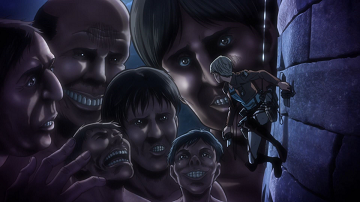
This brings us to the titans themselves. Their presentation is one that straddles the
mindlessness of zombies and the vitality of predators, with just a hint of the
insane in their behavior. They are
deranged idiots, so closely resembling us yet so alien at the same time. Without knowing why they do what they do,
their actions are unpredictable and therefore all the more terrifying.
On top of this, the titans are horrifying for one other
reason: they eat us. This fate, the fate of succumbing to a
creature larger and stronger than us, to in turn be devoured, is the most
primal of fears. Some of Attack on
Titan’s greatest, and most disturbing, scenes are when people are caught and see the mouth opening in front of them. In that moment
intelligence, bravery, and virtue evaporate in the face of unbounded
terror. People scream, they beg, they
flail…and then they die. This
inevitability, taken together with their cryptic nature, is what causes the
titans to be such compelling monsters despite their patently ridiculous appearance and behavior.
Seemed like a nice place to live
Appreciable detail is also given to the overall world. There is a clear geography, consistent
architecture, some history, and of course the iconic 3D maneuvering gear. We are often given small glimpses into the
logistics of the army as well, such as refilling gas canisters or loading up
supply carts for different groups. These
operations are usually supplemented by small vignettes in the middle of each episode, adding a further sense that the
details of the world continue deeper.
Finally, there’s the hype. There isn’t much to say here: the direction
is bombastic, but when it comes to Attack on Titan it works. The sheer scale of the action coupled with the operatic vocal music and intensity
of the imagery comes together to create moments that are simply satisfying.
Our three deep and exciting heroes
The Bad:
Attack on Titan is great when it stays in the realm of
action, but when it ventures into the human sphere it degenerates into pure
melodrama. The directing style that
serves it so well in combat is simply ridiculous when used for human
interactions. Every character, when
saying something of importance, MUST SHOUT IT AT THE TOP OF THEIR LUNGS The
camera will zoom in uncomfortably, and the audience is given the sense that
somebody is screaming directly in our face. There is not even the
slightest shred of subtlety.
This also applies to the characters themselves, who have no
depth to speak of. Eren is our good old
powered-by-youth male protagonist, Mikasa takes on the emotionally-blank girl role that seems to be necessary since NGE, and Armin’s job is to whine. These people exist solely to fuel the action;
they never have a development that doesn’t involve advancing the plot toward
more titans. Any sort of resolution,
such as Mikasa ending up with Eren, will likely be part of
the denouement as a way of giving fans what they want in the end. The side characters are also forgettable, with
no real function except to feed into our main trio or become titan fodder.
Because of these weaknesses, the parts of the series between
the major action moments tend to drag.
After a while it becomes obvious that nothing interesting is going to
happen when only humans are talking on screen, and we must content ourselves to
waiting until the next titan encounter.
This is made worse because the mysteries I praised at the beginning of
the review are never given closure, so many of the conversations boil down to,
“Well, we still don’t know anything. BUT WE’RE REALLY EMOTIONAL ABOUT IT.” Strangely, I am more
forgiving with regards to Attack on Titan for its lack of closure, a point I am
normally a stickler on. I have no
defensible reason for this lapse in rigor, but I felt placated knowing that the
story was continuing.
Review under construction - needs images. Note: Unlike most of my reviews, what follows is a collection forum posts gleaned from the discussion of the series during a group viewing. I have edited a few of them for clarity, but have left them essentially in their original state. Spice and Wolf II - 7.5/10 Post #1: Episode 0 and Discussion
This is the first episode that I have not seen in years, so this was enjoyable to not remember as many scenes. That said, I have a very mixed feeling toward this episode: it is half fantastic and half terrible fan service.
The good of the episode comes from Holo's internal monologues and dreams. They give excellent insight into how Holo thinks. As she muses on how the days, months, and years just slipped by when she was alone she cannot help but feel delight in the daily variety she now experiences. They also demonstrate how self-aware she is of her actions: she knows that at times she loses some control, and is bothered by how much more vulnerable she has become since her long solitude. But at the same time she doesn't apologize for herself, she merely reflects on it.
Easily the most powerful segment is Holo's dream where she finds herself standing on a snow field. On one side are her kin, the wolves waiting for her to come home. On the other is Lawrence with arms outstretched. In this moment she makes a clear choice: as long as he is there, she would like to be with him. But when she reaches him, the reality sinks in that he won't always be there. She will live to see him die, and that is a most terrible thing. Unable to explain this to him it eats away at her. In terms of quality character development, these are top notch.
However, it seems that they decided to also pair this with some profoundly mediocre elements. When I called it "fan service" above I don't mean the sexual variety, but simply that the interactions between Lawrence, Holo, and Nora are for the most part designed to entertain the audience. At the table Holo's forced jealousy, Lawrence's exasperated goodness, and Nora's cute innocence are all excessively highlighted. And later on the scenes involving the flirty interactions at the "sick" bed are just bones thrown to the audience, even stooping to Holo becoming so excited she hits her head (haha?).
Finishing the episode I felt a mixture of feelings. On one hand it's like they had an excellent series of ideas they needed to get across, and they did so amazingly well. I have a soft spot for the grandness of time and our own impermanence, and they nailed that firmly. On the other hand, it seems they feared the episode would be too abstract or depressing, and so were forced to throw in antics to ensure the attention of the audience.
As to Episode 0, the reason I dislike it is because the interactions have no impact. That is, normally their banter has something to do with the plot or is part of shaping their relationship. As much as Holo's teasing drives you (and me at times) nuts, the constant testing also tends to result in certain situations where she realizes she's pushed him too far, or suddenly there bursts through a moment of genuine interaction. These give insight into each of them and are what help us appreciate how their relationship works.
However, during this episode nothing of the sort happens. They play out their parts as established from previous episodes, but as it is adrift between the two seasons it has no relationship to progressing a plot or affecting their relationship. What happens in episode 0 stays in episode 0. I suspect I'm also influenced by some knowledge from S2: (minor spoiler) We never see Nora again. Because of this I can't help but feel that the design of this episode was meant to pander to people who enjoyed the little three-way relationship before it vanishes.
Posts #2-3: Episodes 1-6, irritations
Finished my late viewing of S&W2, episodes 1-3. I honestly don't have a lot to say, mostly because of how it ties in with what is coming up. I figure I'll write out everything then when the first arc is done.
One little thing I disliked about the version I was watching, though, was when Holo is upset and asking to have kids with Lawrence. In my current version she says, "you could make love to me." In the original I watched it was instead translated, "you could mate with me" which I felt was far more fitting.
If S&W is consistent for one thing, it is that it likes to imitate familiar approaches and then purposefully derail them. This arc is no different. On the surface it's yet another, "two guys compete for the affections of a girl" structure. The threat of losing the girl is real to the protagonist who must give it all he has to woo her. The series reinforces this view of the situation somewhat through Lawrence's internal imagery of Holo and Amarty together. In reality Holo was always on his side and this whole mess was to teach Lawrence to trust her and recognize his own feelings. It never was a competition, and Holo thoroughly belittles Lawrence for thinking that.
The problem I have with this arc is that it tries to close with a reconciliation of the protagonists, with the implication that this has further strengthened their bond. Now, I'm not Lawrence but if I found out that I had just spent several days in mental anguish just because my prospective girlfriend couldn't be bothered to talk things out and opted for roundabout manipulation to get the message across, I'd be rather angry. It's like...Holo has a grasp of psychology but no sympathy to accompany it; she just berates him again and again for being an idiot, when as best I can tell he's acting pretty reasonably for a human male. Better than most, really.
Which again brings us back to Holo and her personality. She knows he's a good guy, but she still cannot shake that insufferable manipulative superiority. This whole arc is a result of her not treating him as an equal and talking things out. Instead she views it as her prerogative to beat some sense into him emotionally. It isn't even the little tests the average female does, like seeing if a guy picks up on her cues as a sign of his devotion. She really just likes doing things this way.
So as the arc ends I once again don't attack the writing of Holo. She is who she is. But I do disagree that this event would lead to better relations. If anything it reaffirms the inequality between the two, which is pretty bad for a stable romantic relationship. Also the insight for Lawrence, that he really cares for her, was one that I think the whole audience already knew. What we're all waiting on is Holo to reciprocate.
p.s. Birds > wolves
Post #4: Episodes 7-12
As I watched S2 I was struck strongly how both arcs have exactly the same point: Lawrence chooses Holo over wealth. This insistence on proving the point , however, confuses me. During S1 I never had the impression that Lawrence was a hard-headed merchant who only cared for money. Sure he pesters Holo about her debt, but that is just banter with a small sliver of truth. By the end of the first season it was abundantly clear that they had formed a substantial bond with each other. If I were asked at that point whether Lawrence would part with Holo for profit I would have emphatically answered no. Yet, for some strange reason the entirety of the second season is devoted to proving what we already know.
Anyway, moving beyond that general critique there are two primary reasons I like this arc more than the last one:
1) Holo is back. Like her or hate her, her uniqueness is one of the main claims to fame for the series. When she is absent for several episodes the engagement of the series can't help but suffer. Moreover, now that Holo is back she reciprocates more of Lawrence's kindness. Yes, there are the quips and games and endless meddling but we are given many more instances where she is openly fond of him. She is seen resting her head on his lap, content to let him stroke her head. When he kisses her hand she is actually taken aback for a moment. And when she really is scared, she reaches out to him instinctively. Again, I know this doesn't impress a lot of people but it is a fairly large advance compared to her previous attitudes.
The other aspect of Holo that I disliked during my original viewing but appreciated the second was her suggestion that they separate. I recall feeling quite disgusted at her suggestion that they separate. I felt like they had already been over this and that it was just drama in the making again. However, this time around it made a lot more sense. Previous suggestions of their separation originated with Lawrence, and were often born of practical concerns. This time it was from Holo, and this made all the difference.
Holo is old. For her all things are transient. We see this clearly illustrated when Lawrence comments that people change steadily over time, and her response is, "Yes, just like rivers." Lawrence can't even fathom what she means as he lacks the perspective of time that she does. On this journey she is happier than she has been in a long time, possibly happier than she has ever been in her life. Simply to have everything feel new every day is a gift. But even all this excitement can't shield her from the realization that it will not last. Everything comes to an end. Frankly, when she says that she's accepted Lawrence will eventually die she's just lying to herself. She knows he will die and that there is nothing she can do about it. It reminded me of a scene from Babylon 5 where an immortal being reflects on the burden of his own timelessness:
"To live on as we have is to leave behind joy, and love, and companionship, because we know it to be transitory, of the moment. We know it will turn to ash. Only those whose lives are brief can imagine that love is eternal. You should embrace that remarkable illusion. It may be the greatest gift your race has ever received."
As I watched the series this time it really sunk in just how burdened Holo was with the interminable future. Unfortunately, the scene itself was actually sloppy with some strange cuts that made me feel disoriented. In the end Holo's fear is not addressed and is actually not even meaningful for the rest of the series; it is swept under the rug as Lawrence tries to reconcile with her while not even understanding what she is upset about. I found this quite disappointing in light of how potent this insight into Holo was.
2) The side characters are superior. In the first arc Amarty wasn't bad...he just wasn't great. He did the job he needed to for the story and that was it. Lawrence's merchant friend Mark and his apprentice were similar. I would have loved to see more of Dian (bird woman) but that was not to be.
By comparison Eve is a far more dynamic character. She exhibited just enough self-contradictory aspects to make her feel real. Originally introduced as mysterious and aloof she is actually quite gregarious given the opportunity. Her later deceptions in no way negate this. If anything, they reinforce that coexisting with her cutthroat attitude is a desperate need to be liked and understood that never completely went away. Her life has taught her the hard way that she has to guard herself carefully, but it hasn't extinguished that original spark. Even when she betrays Lawrence it is fear, not avarice or hatred, that motivates her. That she leaves him with the deed to the inn further illustrates that she bears him no ill will. Ultimately she is a sad character who is on a path of self-destruction. Feeling the world close in on her she pursues her ambitions with a mad defiance, if only to prove that she has lived. It's why her last line to Lawrence, that she has hope, is such a sad lie. (That said...can't Lawrence win a single fight in this entire series? Just once?)
Rigoro the scribe and his assistant nun Merta didn't enjoy as much development as Eve, but the way they were presented it hinted at so much more. While Rigoro is clearly educated and wealthy, we do not know his background. His fortune seems to be greater than just what a town scribe would earn so it is likely inherited along with his mansion. The deep cellars with old books would attest to this as well. However, his family is conspicuously absent and in its place is Merta. She clearly can't be his wife, yet she is continually alone with him serving as companion, assistant, and secretary. During the credits we see that Merta goes to Rigoro and that he embraces and comforts her. Aside from her Rigoro avoids the company of others, despite his friendly nature. The final piece of the puzzle is the greenhouse, a dream that is simultaneously extravagant and simple. He not only takes great pride in it, but clearly finds peace within as well.
Taken together, these paint an interesting picture of somebody who has suffered great emotional privation and who now appreciates the simple and quiet beauty of his home and garden. It tantalizes us with the story of two people who have mutual respect and understanding, grown to affection, that cannot be pursued. But rather than view it as a tragic tale, it strikes me as very sweet that perhaps in this world these two people were lucky enough to find a measure of happiness in each other.
Post #5: Summary of S1 and S2
In the end, while this rewatch gave me many new insights into the series my overall assessment remained the same. I have both seasons rated as an 8/10 on MAL, but if I were given more subtlety of ranking I would give S1 a solid 8/10 while S2 strays closer to a 7.5/10. If season two had more focus on side characters like Eve and Rigoro, woven into their interactions with our main duo, it could have been quite masterful. Unfortunately, the unnecessary emphasis on Holo and Lawrence's uncertain-but-not relationship overshadowed these brilliant side personalities.
In the final analysis, what I have to give S&W the most credit for is Holo as a personality. Even as infuriating as she is at times, I know of no other character like her. I never found myself bored while she was on screen. Her relationship with Lawrence is similarly interesting. Even if I was irritated by the way some aspects of it were handled, they form a unique pair in anime with how their relationship forms and manifests itself in their exchanges. Their development is the shining centerpiece of the story.
That said, I fear that this interplay came at the cost of story. It's as icedwarrior lamented in his post for 7-9: that once again the plot was about the personality conflicts between Holo and Lawrence. After a while everything is about whether Lawrence and Holo are getting closer or further apart. They can't just let their relationship slide for a few episodes. It ultimately robs us of the ability to experience anything else in the world. So even as the names and places change, there begins to creep in a sense of sameness about everything that happens. I suspect this is yet another contributing factor to why I prefer S1 over S2: things are still fresh in the first season before the repetition sets in.
And with this, I leave one of my favorite AMVs: Spanish Wolf. I find myself often returning to it as it captures the best the series has to offer: the joy of living and traveling, the give and take in the turbulent partnership between Lawrence and Holo and the romance that unfolds and deepens over several seasons. And of course, the rampant alcoholism.
Review under construction - needs images. Note: Unlike most of my reviews, what follows is a collection forum posts gleaned from the discussion of the series during a group viewing. I have edited a few of them for clarity, but have left them essentially in their original state.
Spice and Wolf - 8/10 Post #1: Episodes 1-3, Holo’s Personality
S&W is one of the few series were most of the nudity doesn’t bother me. I’m normally part of the Prude Police, but S&W knows how to frame situations properly. A good demonstration of the writers’ conscious understanding of how to frame females is in the comparison between Chloe and Holo in the first episode. While Lawrence has no romantic inclinations toward Chloe, when she lies down on the hay and comments that she has grown up his eyes can’t help but notice this fact. The way they frame those shots and then cut to Lawrence’s face clearly indicate that we’re being treated to Lawrence’s point of view, not just being given shots of a pretty girl for fan service reasons.
Later on when Holo is getting out of the cart she is stark naked but the way the situation is handled manages to keep it from feeling like it’s just there for sex appeal. Her being naked is natural; she doesn’t give a second thought to it and neither should we. The only compromising shot is yet another that is clearly from Lawrence’s point of view: when she bends over to pick up the jerky and looking at her (nicely rounded) buttocks he notices that she has a tail. So the scene which could be a train wreck of bloody noses and shallow fan service manages to wordlessly demonstrate to us how Holo views her body and how we as the audience should as well.
One thing that is interesting to note is that later in the second episode when they are drying off in the inn Lawrence does become embarrassed at Holo being naked. At first I thought maybe this was inconsistent, since he didn’t display any of this in episode one, but on further reflection I think it could be argued that he is becoming familiar with her as a person now. Even if she doesn’t care, his maleness does.
Continuing on to Holo herself as a character, I’ve always had a very interesting time trying to pin her down. I know she is a fan favorite, but I don’t think most people appreciate a simple fact that is stated in the first episode: Holo is Holo. She is her own personality that is not any particular trope and doesn’t play to what people want. She is very old and experienced, despite appearances. However, she knows the effect her appearance has and smoothly abuses it to get what she wants. The only reason she isn’t a villain is because what she wants is usually fairly basic (apples!) or more or less good-willed (helping Lawrence). In short, she is highly, but benignly, manipulative.
This is the reason that again, despite her popularity, I really don’t think people appreciate how dangerous she is. Not in a “wolf eat you” way (although that is also true), but in the fact that in scene after scene she is content to play with Lawrence. To tease him, to excite his emotions, and then to stomp them. It’s her pastime. This is somebody who is very adept at wearing a mask and only rarely lets what she thinks and feels through, instead pretending to be many different things and watching other people react. So in short, even though I admire Holo as a character I have never thought that she would be an amazing person to be with in real life.
To finish up, I have a question for people: where do you imagine S&W taking place? I’ve always imagined either southern Germany or northern Italy given the names, but never could quite decide on which.
Post #2: Episodes 4-7, Lawrence
I like this first arc, but I will be honest I still don’t 100% understand how the deal worked. More specifically, they never answer the original question which is: why were Lawrence and Holo targeted by Medio Trading? They bring this up as a bizarre choice by Medio Trading since Milone Trading wouldn’t care that much. Is the implication that Chloe recognized Holo‘s name and authorized the hit out of a hunch? I just never got it.
Which brings me on to the second point, and that is Chloe’s involvement in Medio Trading. It strikes me as terribly anachronistic that Chloe would be a major player in a powerful trading company. The author even seems to realize this: she’s surrounded by grizzled old men who would naturally be the leaders, so a young pretty farm girl sticks out like a sore thumb. The interaction she has with Holo is important, but the fact that she’s there at all has never settled well with me. (Note: I was later told that Chloe is anime-original, and therefore clearly grafted in.)
Finishing for this week I want to take a look at Lawrence’s role in the series. Lawrence is not an extraordinary person. He demonstrates a heightened degree of intelligence and cunning, which has made him into a successful merchant, but beyond this he is relatively unremarkable. I don’t state this as a bad thing, simply that it’s important to appreciate the incredible task Lawrence is up against: keeping up with Holo.
This is what makes Spice & Wolf different from most romantic series. Usually the role of males is more dominant: the guy is the one taking care of the problems. He protects the girl and through his effort woos her over. And at first Lawrence tries to do just this. He attempts to show off his business savvy, pose questions he thinks she can’t answer, and protect her when they are cornered by Medio Trading. But the truth is, she’s just as smart as he is and has centuries of experience that make her far more capable in nearly every regard. She gets better deals, figures out his riddles, and saves them both by turning into a giant wolf. Everything he can do she can do better.
The result of all this is two-fold. For Lawrence it means that as his feelings for Holo grow he has to figure out and overcome his own bruised ego. It isn’t a grand transformation, and in fact the series remarks little on it, but it is still a journey that adds a layer to his character. For the audience, it serves as a warning to not expect these roles or even find them desirable, for as we are reminded, “All men are jealous idiots, and all women are stupid to be happy about it. Idiots are everywhere you look.” Post #3: Episodes 8-10, Concerns and confusion
After the last series of episodes we’ve seen Holo and Lawrence get through their first major ordeal together. This shows from Lawrence’s perspective – he is steadily more willing to trust and confide in her. However, for me Holo becomes more abrasive as she eschews any typical signs of increased intimacy for more teasing and abuse. This isn’t a criticism of the writing necessarily, as it would entirely appropriate for her character to try and distance herself from mortals by ensuring that they know their place, if even in jest. That said, from a human perspective it really starts to hurt because she just won’t give him a break.
This irritation with her distancing act is actually exacerbated by her over-fondness for foods shown in this arc. I am unsure if this behavior is meant to make her more relatable or demonstrate a flaw in her personality, but it comes across as clownish to me. In this instance I have a harder time giving the series credit for good writing because it feels so at odds with her normal behaviors. For instance, her drooling at the thought of honey-soaked peaches is truly inelegant. Holo, if nothing else, prizes that vision of herself and reacts negatively when it is questioned (“You snore.” “I do not snore!” “Just a little bit…” “NO! I DO NOT snore!”) That she would then make unreasonable demands to wake up the merchant and sell their wares and immediately leave the city doesn’t appear to be teasing but a truly thoughtless course of action brought on by her fixation. Having a soft spot for sweets is one thing, but it seems to be played just a bit too heavily to be in accordance with her overall character.
All this taken together is why I am happy when they meet Nora. I feel just like Lawrence: grateful that there’s a normal human female around. One that I don’t feel constantly on edge with, not knowing if I’m going to bit bitten. Also doesn’t hurt that that I apparently have the same taste as Lawrence…
The last thing I want to both comment on and ask about is: what went wrong in his deal? And why is it labeled as greed?
So I understand that he caught the guy trying to cheat under the name of God, and that both as a merchant and good churchgoer his reputation would be ruined if it got out. He then squeezes the guy for double but asks for it in armor as goods. (1) This somehow incurs a debt to the merchant? I honestly don’t understand, because I thought he was trading for pepper not buying on credit. Either way, his debt becomes far worse when he finds out that the armor market is greatly devalued and that his goods are nearly worthless. But then this debt is transferred from the merchant to Lapatron Trading, which means he’s in debt to them and cannot pay it because his armor is worthless. (2) Why was his debt transferred?
These points, (1) and (2) are what I just don’t follow. I don’t understand why he had a debt when he appeared to be trading goods, and then why and how his debt was transferred. If anybody could help explain, I’d appreciate it as economics is…not my forte.
@icedwarrior I also noticed the huge quality drop in a few scenes as well. I’m not sure if they were there before and I just noticed them now, or if these episodes suddenly have that issue. Also to answer one of your complaints: The reason Holo accompanying Lawrence is a problem is because of the appearances. They are in a church-run town and a man has fallen on extremely bad times. In other words, in his friends’ view Lawrence has likely done something to anger God and this is his punishment. Not only this, it’s pretty obvious what he’s done: he’s dragging around town with a girl that can only be his mistress. But in their view, he isn’t even trying to help himself. He isn’t trying to change his life of iniquity, and a mistress is sure to be a money sink as well. Yet he parades her around in front of them while having the gall to ask for money. This is why he is consistently turned down, whether with nice-sounding excuses (“We need to save money for the crop season…”) or with water being thrown in his face. It isn’t until the last man that he realizes what has happened.
Post #4: Episodes 11-13, Finale and Holo in depth
These last three episodes are some of my favorites in the first season.
As I remarked before, what I dislike about the last set of episodes is that Holo‘s temperament doesn’t improve. They just got through a tight spot together and they are obviously meant to become closer, but suddenly Holo reverts back to her initial level of teasing without any balance of visible affection. While this may be accurate writing (more on this below) it still irks me and I find myself feeling quite annoyed with how she is portrayed. In the final episodes the series this is amended and, at least for me, feels more natural.
The primary scene that illustrates this is in the inn at the beginning of episode 11. I like it because Holo is earnest, while not completely losing what makes her unique. She acknowledges from the beginning that having her hand brushed away before was minor, and knows that the damage she may have done to Lawrence’s life is irreparable. Yet he has the gall to apologize for his minor transgression, and that shames her terribly. It’s really the first moment where I think she realizes maybe she isn’t superior to Lawrence in all ways. Holo has great personal pride, and while she acknowledges to herself that she is fond of him** she also has a fundamental attitude that he’s the lucky one to be with her. In this scene I think she first realizes that maybe, just maybe, she’s also lucky to be with him.
Being Holo she is far too proud to say this out loud, but what she does next is telling: she basically demands he confess to her. She suddenly wants to hear, to really know, that she does have his affection. Her domineering manner in which she has him retry it until he ‘gets it right’ is pretty typical of her powerful personality, but despite that she still earnestly wags her tail at the end – a sure sign of her true feelings. Between this and other scenes (such as when she kneeled and begged for Lawrence’s sake with the wolves)I feel like this series finishes itself well in the portrayal of their relationship, striking a good balance between teasing and underlying emotional bonds.
And speaking of the give and take, the final couple of scenes are also some of my favorite. Finally, Lawrence gets Holoback. The look on her face when he tells her that he probably called her name because it was shorter is priceless. And when she tries her heavy-handed approach like she did back in the inn, trying to put herself back in control of the situation, he completely turns it around by calling during the bells. And all this only works because we now know how much Holowants Lawrence to like her, again emphasizing how I feel this arc better sculpts their relationship
Other than this, I like Nora. She isn’t an award-winning character by any stretch. She is too young and we don’t know her for long enough to get more than the basic story behind her motivations. But despite being a slight, innocent, frail-looking girl she shows that she can look after herself. Her scenes involving the wolves are really serious. Just imagine what it would be like: middle of the night, in a dark and unfamiliar wood, you wake to the sound of wolves surrounding your camp. That is a primal human nightmare, but Nora has the ability to stand there ready. Even when they are fleeing she doesn’t panic, but instead acts intelligently to disrupt the wolves’ behavior. It’s really as Holo says: don’t confuse this girl for a sheep just because she looks tame. I don’t really see it as a “girl power!” kind of thing as much as yet another case where the series seeks to purposefully disrupt the usual stereotypes.
Finally, I have to admit that the last few episodes do highlight how poorly non-humans are drawn in this series. The scene where Holo attacks the thugs from Lemerio Trading is particularly atrocious. The action doesn’t flow and many of her movements look profoundly unnatural. I think it’s just as well that the scenes with Holo‘s wolf form are few and far between. Enek also looks really strange in many of the scenes he features.
**Addendum on Holo‘s Personality
I think sometimes people confuse Holo as a tsundere because she keeps herself distant at many times and has occasional violent outbursts. However, I really do not think that is accurate.
Tsunderes are motivated by the repression of strong feelings. Unable to handle their own emotions they are overwhelmed and try to cover them up, often even to themselves. This creates a very unstable personality because they want something so badly yet go about getting it in all the wrong ways. In particular they frequently turn to violence in their confusion, seeking to give the impression that they are not besotted as well as perpetuating a self-image of being in control (which they are clearly not). Over time they warm up if the male is patient enough to put up with their antics, soothing their fears of rejection.
Holo does not have these kinds of internal conflicts. She has a great deal of self-confidence and knows what she wants and how to get it. She readily acknowledges to herself that she has feelings for Lawrence as well. Her distance from him is not due to confusion. It is because of two things: pride and fear. Her pride as Holo the Wise Wolf means that she simply has a hard time weakening herself in front of others, especially inferior humans. Expressing affection always makes people vulnerable, and so she cannot bring herself to openly show her affection on a regular basis.
The fear is something I already touched on above. In the inevitability of time, she knows that she will outlive Lawrence. As she already has said herself: she is tired of being alone. She knows deep within herself that these times can’t last and that she can have no illusions that their love is ‘eternal.’ In this regard she finds herself drawn in with the moment, but also struck suddenly by a deep melancholy that has no answer.
“Enjoyment appears at the boundary between boredom and anxiety,
when the challenges are just balanced with the person’s capacity to act.” –
Mihaly Csikszentmihalyi
“…satisfaction has to be seen as lying in a considerable
series of transactions, in a trend of behavior rather than a goal achieved.” -
Robert White
Shirobako is a charming ode to teamwork and dedication. Composed of equal parts humor, friendship,
and stress (okay, mostly stress), it follows the everyday trials of Miyamori
Aoi, a novice production assistant at Musashino Animation, as well as the
experiences of her close friends from high school. Together they have sworn to make an anime
together some day and have entered into various anime-related fields (animation,
CG, voice acting, and writing) to pursue this dream. What raises Shirobako above the hordes of
“cute girls” series is that at the core it has a firm grasp on both the
pressure that young people experience entering the work force as well as the
joy that comes from dedication to that same work.
This grounding is what sustains Shirobako. It is the fountain from which all its best
elements flow, and the writers knew this.
There is no high drama, just the mundane interactions between people at
an anime studio. Action would be
disingenuous, and romance distracting.
It has a great deal of friendship, but it is the subdued variety,
reserved for professional relationships and after-hours relaxation. It also tastefully declines to stoop to
boorish fan service, being confident enough in its foundation to stay the
course.
By sticking to its core themes, Shirobako allows us to
follow along with the journey and, if we’re lucky, get just a small taste for
ourselves.
The Good:
Increasing research shows that the crucial elements of
happiness and satisfaction in life are a result of having one’s skills and
interests be aligned with the task at hand, and that the result of these labors
produces something of value to the world.
Shirobako takes these rarefied ideas and communicates them with a
special verve that only a story can contain.
As a viewer, I experienced viscerally the struggle and uncertainty many
of the characters were going through as they forged toward their dreams. The simple challenges of overcoming
self-doubt, frustration with failure, and the fear that their best was not good
enough were eminently relatable. And
mixed in occasionally, those shining moments where all that they have endured
comes together, and the realization that they have truly accomplished something
sinks in. Rarely has a series caused me
to empathize so much with the seemingly trivial, yet vitally human, feelings of
its cast.
The best of this is seen in Miyamori. When people think of meaningful jobs,
production assistant does not make the list.
The natural choice would have been to focus on a creative role, such as
director or senior animator experiencing a grand sense of self-actualization. Instead she is an office worker, organizing
time tables and acting as the go-between for the departments. It is thoroughly non-heroic work. After all this talk of vital engagement, she
seems a poor vantage point to see it in action.
And yet, we are pleasantly surprised.
It is not the job that makes the meaning, but the way it is
approached. Miyamori’s sincerity and
struggles are not diminished for the apparently unremarkable nature of her
job. There is an art to being the one in
between, and it is no second-hand happiness to support others. (Significant spoiler)
Supporting others is a "win-win" situation.
Miyamori’s sister also deserves mention for her role as a
foil to what goes on with the main characters.
When she first visited I found her obnoxious, but she grew on me as I
understood the source of her behavior.
Her job was meaningless.
Every day she put on a meek disposition and followed the company
line. It was a potent reminder that not
all work led to the experiences that Miyamori (junior) had. What I had tagged as “excessive” made more
sense in light of realizing how she had to express herself elsewhere, for her
everyday life was nothing more than a way to pay the bills. By the time she left, I felt a bit sorry for
her; it put what was happening in Shirobako into perspective.
Paired with these themes of fulfillment (or lack thereof) is
a pointed expression of what it is like to be a young adult first stepping into
the world. In high school dreams seemed
easy and exciting, but now real life has overtaken them. Each of the girls face their own challenges,
from figuring out their passions to improving their craft. It is disorienting, terrifying, and exhilarating
all at once. Shizuka is particularly compelling. She spends most of
the series on the sidelines, not knowing whether she’ll ever make it into the
hyper-competitive field of voice acting.
It was a bittersweet mixture to see her continued dedication in the face
of repeated disappointments. As
somebody who never experienced such pressure, it came through loud and
clear. Once again I was impressed by the
effectiveness with which the series explored this feeling while not becoming overly
burdened by it.
Stupid tires...
Finally, no praise of Shirobako would be complete without
mentioning its insight into the anime industry. While I am certain that
somebody will stop me and clarify that some parts were not accurate (I highly
doubt that the average studio has such a high density of attractive young
women), I came away from it feeling I knew more about what went into the
process. It heightened my appreciation for the blood,
sweat, and tears that go into anime’s creation, as well as the generational
sense of how anime has evolved as a tradition.
The episode where they visited the old building was easily one
of my favorites for showing how our current characters were carrying on a
tradition, putting into perspective that their current struggles were what
would create the foundation for the future. In the end, it simply made me grateful for
the anime I have come to enjoy.
The Bad:
Characters in Shirobako are not particularly developed. This is not a bad thing. Arguably, too much individual detail would
fatally sidetrack it with a cast of this size.
It is best to hint at the depth of everybody with occasional glimpses
rather than attempt to fully explore them.
However, this approach only works when we are given reason to respect
the characters, and there are a few that come to mind that fail this test
miserably.
The worst offender is clearly Tarou, Miyamori’s coworker at
the production desk. Despite featuring
prominently in nearly every episode, he has absolutely no development. He exists purely for comedic relief. The series passed by several opportunities to
enrich him. Something as minor as a
serious answer to why he worked in anime would have sufficed. To know that there was somebody in there who
had serious, realistic needs and dreams would have gone a long way. I also had a love-hate relationship with Kinoshita
(the director) as well. We do have some
reasons to value him, but he was cast in such an unfavorable light that it
seemed like the message was often, “pity the silly fat man.” It’s important to show that people have
faults and can still work together as a team, but these two felt entirely defined
by their flaws.
There's unimpressed, and then there's Miyamori unimpressed.
Also on the topic of mediocre characters, the dolls that
represent Miyamori’s thoughts wore out their welcome part way through the
series. Early on, they were a clever way
of showing her inner monologue: she wasn’t a perfect angel but had several
conflicting impulses, many of which were not generous. But somewhere around the halfway point the
dolls began to take on a more active role, narrating scenes and explaining
situations. These were no longer
Miyamori’s thoughts for herself, but obvious expositions for the audience. This expansion of the role felt unnatural and
ultimately made the dolls feel ridiculous.
Finally, I struggled with some of the sillier aspects of
Shirobako. Above I praised the series on
how grounded its drama was, not relying on artificial inflation. They unfortunately did not follow the same
strategy with the comedy, which had a tendency toward complete
ridiculousness. The scene at
the end where the director storms the office building was humorous….and
completely out of place for the importance of the situation. It took me out of the flow and dulled the
impact of the rest of the episode. This was also true on occasions when the series tried to push the
emotional moments with odd…hallucinations; the three girls of Exodus! and
the boat with the warriors appearing at the end stood out to me as simply poor
directing choices that toed the line between strange and sentimental.
Speaking of Exodus!, my own personal enjoyment of the
series was often impaired knowing that despite the wonderful teamwork that was
going on, it was all for such run-of-the-mill trash series. I know it doesn’t invalidate their
experiences together, but it made me sigh a little to know it was all to bring
such vapid stories to life.
I entered into watching Shirobako with many
reservations. It seemed too flippant,
too reliant on cute girls and cheap sentimentality. I was gladly mistaken. Shirobako is a series that is entertaining,
informative, and genuinely touching. It
holds its level of quality to the end and is a recommended watch for anime
viewers.
No introduction, but here's a picture of Shoemaker-Levy 9 comet striking Jupiter in 1994. It hit with enough energy to leave Earth-sized marks on the outer atmosphere.
I went into the movie expecting certain things (romance, beautiful scenery, etc.) but what I did not anticipate was the comedy. This caught me by surprise as the few Shinkai works I have seen featured little in the way of jokes and relied far more on the heartstrings. The Freaky Friday routine was surprisingly enjoyable, how it unfolds slowly and with only one half at a time, then moving together. Even the simpler gags, such as Taki(Mitsuha) fondling "his" breasts, became good running gags. My personal favorites of this part were the pronoun confusion by Mitsuha(Taki) on the school roof and when Taki(Mitsuha) finally completely freaks the younger sister out in the morning. Most of my enjoyment of the movie is derived from this first segment.
The more humorous early segments also did an excellent job of laying the groundwork of the latter half of the movie. The characters were far more endearing for having laughed with/at them. This is also a seamless way for us to learn more about our two main personalities; what they like doing, what they do with their time, their aspirations, their quirks, etc. all flow naturally from them having to explain to each other what to do and not do while in the other's body.
The preparation also deserves some praise for what it doesn't talk about: namely all the characters that don't matter. This is probably a case where I'm more used to series than movies, but the movie knew which characters were relevant and important and didn't waste our time with the others. We see enough of the main duo's families to know their situations, and enough of the associated friends to get a taste of their personalities. And then nothing more, which is exactly what is needed.
Moving onto the latter half of the movie, what caught me the most was that Mitsuha was dead. It really did put a hook in me when they discovered the destroyed town, and ultimately reading her name on the registry of victims. The first part of the movie really did do its job with selling her. Her "first" death scene was also solid for its unexpectedness.
Finally, it goes without saying nowadays, but Shinkai's films have a top animation budget so they look good. Although in this case, some of my favorite animation was actually during the flashback Taki has from drinking the saké. The chalk-stylized touch was enjoyable. This isn't to disregard some of the grander shots, such as the view Taki has of the village at sunset, but the obvious push for the wow-factor in the scene slightly dulls it for me.
The Bad:
Shinkai loves to insert supernatural elements into his movies, and honestly I think they are usually the worse for it when things turn serious. What worked as a humorous plot device to get to know our characters now turns into a convenient tearjerker way to have them forget each others names and be forced to find each other. This type of complaint is the same I have made for series from Shiki to Clannad: I have a hard time getting any emotional traction with excessively artificial situations. Cases of mutual retrograde amnesia are just not common enough.
My other primary problem with the end was the pacing. I know that the staggered uncertainty is what people pay for, but for me it just felt dragged out. From the moment that Taki goes back in time from the shrine, it is clear that the villagers will survive and our couple will get together in the end (if there was any doubt before, I guess). All that remains is to execute the final arc. When we snap back to the present the movie delays confirming that the village survived (we know they did), then dilly-dallies around with whether Taki will see Mitsuha in Tokyo (he will), and finally has them miss each other repeatedly until the inevitable conclusion (of course). Again, I know this is what makes the movie so broadly popular, but for me it's simply cheap.
Ultimately, I still thought it was a solid movie. I enjoyed the viewing and would recommend other people to go, but I would not consider it a moving masterpiece that it has been built up to be.
Mobile Suit Gundam: Iron-Blooded Orphans (S1 and S2) - 7/10
As a franchise, Gundam explores the meaning and effects of
war. However, the quality of each series
varies greatly with the premise being periodically undermined by immature
attitudes and pseudo-intellectual exposition.
Often the gains made by depicting senselessness on the battlefield are
promptly countered by melodrama and sentimentality. True suffering gives way to teenage
angst. Because of these tendencies,
Gundam as a whole is shackled to its more adolescent underpinnings, with giant
robots as nothing more than a proxy for having superpowers.
Iron-Blooded Orphans defies this trend and is one of the
stronger submissions to the Gundam franchise.
Driven more by the characters than the machines, IBO uses past suffering
as a backdrop rather than a plot device.
The story centers on Tekkadan, a mercenary band composed of child
soldiers who have rebelled against their former overlords. Led by Orga Itsuka, this misfit collection of
human debris must now face a society indifferent to their struggles. In the process, they discover a sense of
belonging and camaraderie that they have never experienced.
With this as a backdrop, IBO is far grittier than most
Gundam series. There is no glory in what
the children of Tekkadan do; it is an act of survival, not honor. This can be seen most clearly in Mikazuki
Argus, the ace pilot of the company.
Unlike many protagonists he does not view his opponents as rivals. They are obstacles, nothing more, and he will
crush them without hesitation or remorse.
So it is with the rest of Tekkadan, desperately fighting to continue
living in an apathetic world.
The Good:
The inherent quality of the plot. Despite the inadequacies of the execution
(more on that below), I would argue that IBO has one of the strongest Gundam
stories to date. The essence of the
series is anti-heroic. Combat is not
admirable, idealism can be dangerous, and determination does not always win the
day. Nowhere is this seen more clearly
than in the ascension and demise of Tekkadan.
As the story begins, we are treated to a familiar narrative:
a downtrodden group finds an inner strength, rebels against the established
order, and will now change the world.
However, Tekkadan is composed of uneducated children, wily in combat but
inept at intrigue and politics. While
early on their strengths are enough to carry the day, it was blind luck that
led them to a kindly patron in the Turbines, a conscience in Kudelia, and
diplomatic backing from Makanai. This
sort of fortune does not continue forever, and soon Tekkadan found itself in
over its head. Having risen into the
ranks of power, they came into contact with those who knew how to wield it
before they themselves were prepared.
Their boldness was an unwitting challenge to the greater forces of the
Earth sphere. Seeing this coming, Biscuit
urged Orga to restraint. But with his
unfortunate passing there was nobody left in Tekkadan to keep it from plunging
forward into disaster.
It is in this final segment that IBO is at its
strongest. The narrative is
uncompromising: an intrepid spirit alone is not enough to overcome any
obstacle. While we have come to believe
in our heroes, as they have come to believe in themselves, there is no
last-second miracle. The resources and
planning of their enemies, as well as their willingness to use unscrupulous
means, prove to be too much. And so ends
Tekkadan, with a last stand of its greatest warriors, guarding the exodus of
the rest as they seek asylum and anonymity on Earth.
But what threatens to be a dismal conclusion is ameliorated
by the subsequent events. Although our
heroes fell, it was not entirely in vain.
Gjallarhorn was not defeated, but the strife caused by McGillis and
Tekkadan did force it to restructure and become more accountable for its
actions. Human debris, formerly a blind
spot for most of society, was thrust into the limelight and abolished. Even though Tekkadan itself may have failed,
it is not forgotten. This was a
surprisingly satisfying end, offering hope while not betraying the ethos of the
series.
In addition to the story, the depiction of combat adds
weight to the view that strife is not glorious.
In most mecha series the fights feel clean, antiseptic, distanced from
the human element. In IBO the fights
have a sense of dirty desperation. The
fighting continues until the pilots are beaten and bloodied,
their suits in shambles. The ragged edges, the
dripping oils, and the shuddering half-functional maneuvers all contribute to
the feeling that this is not merely for show, but an engagement of life and
death. While there are many examples,
several of Mikazuki's battles come to mind: his annihilation of Carta Issue, the dismantling of the Mobile Armor, and his last desperate stand all
exemplify the merciless, animalistic scramble that is IBO's war.
This brings us back to Mikazuki Argus. Having seen multiple Gundam series, it
becomes an expected trope that the top pilot is a cold and emotionally distant killing machine, with
nothing but the mission on his mind.
However, inevitably, it is discovered that he has a good heart underneath and it has only been repressed by his tragic past. An ideal vessel for the adolescent male
viewers to self-insert and fantasize with.
Mikazuki is nothing of the sort.
A true case of emotional damage he is devoid of any internal moral
compass, only beholden to Orga who acts as his anchor and handler. Mikazuki is composed but fanatical in his
devotion and is unfazed even by his later progressive paralysis from
excessive use of the Alaya-Vijnana system in combat. As he tells Orga: "Just tell me what to
do and who to kill. I will remove all
the obstacles before you." He is
completely broken, but is a far more compelling character for it.
"Thank y-"
The Bad:
If I had to pinpoint one crucial failing of IBO, it is the
lack of consistency and subtlety in storytelling and character
development. My exposition of the themes
and plot above come only after extensive review and contemplation; during the
actual viewing of the series I was lost.
First, while IBO can boast many outstanding scenes, the bulk
of the episodes between these moments were implemented poorly. The pattern was often the same: in
preparation for a key situation we are suddenly introduced to characters,
organizations, or technologies with which we had little or no previous
awareness. Given a short run up, we have
little time to incorporate them into our understanding. And once they had served their purpose, they
are gone, never to be heard from again. Mobile Armor, Dainsleifs, the orbital Earth colonies, the
separatist Mars groups, Makanai, and the elections of Arbrau just to name a
few.
This weakness in storytelling also extends to the characters
of the series. IBO has an ambitiously
large cast, but is unable to adequately support them all. We hardly get to know most of them, good or
bad. Take for instance Rustal Elion,
commander of the Arianrhod fleet. As the primary antagonist of the end of the series, one would
expect us to know more about him. Yet,
he is only given a cursory introduction.
With no prior development, we can only be left confused as he is first
presented as a regressive-but-respectable member of Gjallarhorn, to an
underhanded tactician willing to exploit banned technologies, to an effective
leader that heads a reformed Gjallarhorn in wake of the events of the
series. If the writers had
been more skillful I would take these to be dynamic facets of a complicated
character, but instead they feel disjointed and opportunistic.
Nowhere is this lack of development felt more strongly than
with the members of Tekkadan itself.
Despite having 50 episodes to work with, most of them still felt more
like stand-ins. This is especially
devastating when many of them begin to die in the final arc, and I did
not know who some of them were. It is not enough to focus on a character for a scant few episodes while
they are "important." Without
the small touches that endear us, the non-essential points of development that
remind us of who they are, we cannot invest in them as an audience.
As this two year saga comes to an end, I find myself both
impressed at the scope of the narrative and frustrated by its inexpert
execution. Its strong themes, battles,
and death scenes (Lafter...) were often lost amid the
disorganized wash of events. However,
the series stayed true to itself and stuck the landing, being engaging up until
the last scene. It is a worthy
submission to the genre and I look forward to future Gundam series if they have
as much heart as this one did.
Social ostracism is a human universal: in order for there to be a group there must be outsiders. Those with obvious differences are the natural choice. Koe no Katachi is a story about the people on both sides of this experience.
Shouko Nishimiya is a deaf girl who has recently transferred to a new school. However, her hopes for a fresh start are swiftly dashed when Shouya Ishida, a rambunctious but fairly normal boy, chooses her as the class pariah for his taunting and other antics. This triggers an avalanche of abuse as the inconveniences caused by her disability become the grounds for her wholesale rejection by the class and teacher. In the end Nishimiya is forced to transfer schools once again. Unfortunately for Ishida the spite that was formerly directed at Nishimiya becomes focused on him, resulting in his own social isolation.
Years later in high school Ishida again meets Nishimiya, but with newfound empathy he seeks to atone for his bullying. The resulting events of the manga lay them both bare, and they begin the slow process of healing together.
The Good:
The terrible clarity with which Koe no Katachi portrays the mentality of both the victimizers and victim is the bedrock on which the series is founded.
First there is Nishimiya. Born deaf, she fundamentally cannot forgive herself for living. She blames herself for her parents’ divorce, for the inconvenience caused by having to keep transferring schools, and ultimately for her own bullying. It is the sad logic of the isolated that they believe they are at fault for their own suffering. And since they are at fault, they are convinced they deserve it so as to remind them of all the trouble they have “caused.”
Next is Ishida who is given an insight into this same state after his elementary years. However, as one who has fallen from acceptance his feelings are somewhat different. While he also regards himself with a level of self-hatred he seeks to fix his mistakes. That is, while he loathes himself it is because of what he has done, not who he is.
This distinction may seem small, but its effects are profound. This can be most readily seen in the chapter leading up to Nishimiya’s attempted suicide. Some may question why Nishimiya chooses this time to try to kill herself. The answer is simple: she is too happy. Here she is with friends now, enjoying herself. It isn’t right in her mind. She deserves suffering. Ishida doesn’t think this way: while he also beats himself up, he seizes upon potential acceptance with a fierce hunger, such as when they attend the amusement park as a group. He ultimately holds out hope for light at the end of the tunnel while she does not.
Last, I’m going to use Naoka Ueno, one of Ishida’s classmates that joined him in bullying Nishimiya, as a prime example of the tormentor. Ueno is driven by her own desires and has reasonable self-esteem. She isn’t evil so much as interested in her own well-being and willing to sacrifice the well-being of others for it – in other words: a distressingly normal human.
What is telling is when Ueno is faced with Nishimiya’s reflexive self-sacrifice she is incensed. She wants Nishimiya to fight back, to give her justification for her actions. But this fury more deeply stems from a lack of comprehension. Ueno fails to understand Nishimiya because she cannot envision what it is like to not value herself. It is completely beyond her ken. She can only conclude that Nishimiya must be putting on an act, abusing her status as “disabled” to garner sympathy.
Another wonderful aspect of Koe no Katachi is its detailed drawings of faces and hands. As a series that must portray the thoughts and feelings of a character who cannot speak them herself, Koe no Katachi devotes beautiful effort to ensuring that her voice is heard. There are honestly too many pages to name where I was impressed once again by the detail given to the small details of expression.
Finally, while Koe no Katachi has many outstanding pages, there is one in particular that touched me more than any other: Nishimiya’s resolve in Volume 6, Chapter 45, pg 17-18 (read right to left). A few pages before we see Nishimiya’s younger self, battered and hurt, expressing to her sister one desperate wish: “I want to die.” This is not an idle thought or a petulant outburst after a bad day. Nishimiya, in her soul, does not believe she deserves to live and be happy.
But in the aftermath of her attempted suicide she has been confronted with something that she never imagined: her self-hatred had hurt those closest to her. But, this anger…it was for them wasn’t it? Didn’t her mere presence cause them pain and grief? How arrogant could she be to ever think that a nasty, useless creature like herself had the right to forget this?
…
And yet…they cry. Her mother, her sister…even Ishida…they cry for her. Why…? Was she…was she really worth that? No…yes? She had hurt them again, but…they loved her still. She has been hurting alone inside for so long…does she deserve to now cry with them, for herself?
In this moment of remorse, pain, compassion, and release Nishimiya feels for the first time that she has value as a person. I cannot emphasize enough how hard it is for her to do this. Her whole life has been built on believing she is nothing. To turn this around is possibly the most difficult thing she has ever done. And as the chapter closes we see her realizing the truth: she has to live.
The Bad:
Without a doubt, the weakest portions of Koe no Katachi are the final 8 chapters. Nishimiya’s attempted suicide is the climax of the series. In that darkest moment everybody’s worst fears are realized. The aftermath of this event lays bare the realities of the situation: that half measures and kind intentions were not enough. But at the same time, it offers the hope that having passed through this ugliest of times people may renew and strengthen the bonds between them. Ending with Ishida’s reunion with Nishimiya on the bridge, after both fearing they may never see the other alive again, was a perfect finale to this arc.
This is, in my opinion, where the manga would have best ended, with perhaps a couple of chapters afterward to round things out. Instead we are treated to a lengthy and somewhat meaningless denouement, where details that did not matter before are given extensive coverage. How all the characters would spend their futures was of no concern. Nor, really, was the movie they were making; the entire scene where the professional artist berated their poor production was particularly underwhelming.
What made this worse for me was also the unfocused and ambiguous nature of the “friends” at the end. I hold Koe no Katachi in very high regard for most of its psychology, but in this area it was tenuous. The behavior of many of the characters in the hospital continued to reinforce that they were still focused on only themselves. Kawai’s speech in particular was disgusting with its self-serving pantomime of compassion. And yet, in the last few chapters we are shown that apparently Nishimiya is to continue to spend time with these people that resent and despise her, and that they are actually going to build a bright future together. This goes beyond forgiveness into the realm of masochism. Up until the very end of the series I felt uneasy, waiting for Ueno or Kawai to make another move; this isn’t the feeling one should have if they’ve truly become friends. As such, this aspect of the resolution felt false to me, as though the author was caught between realism and a storybook happily ever after, and in the end faltered for a confused compromise.
The other notable weak point of Koe no Katachi is Ishida’s “best friend,” Tomohiro Nagatsuka. In a series full of amazing characters, he is a caricature. We learn almost nothing about him, except that he is slavishly devoted to Ishida because of his lack of friends and he has dreams of being a director. He receives no development and his main purpose is to act as hybrid of comic relief and font of positive energy. Even his visual style doesn’t match the rest of manga. That I never took him seriously as a person is the harshest critique I can give.
Finally, I want to leave a remark about the captions at the beginning and ends of the chapters. They were terribly mismatched with the tone of the series, frequently full of phrases that sounded like cheap commercial endings. “What will happen next? Only the clear blue sky knows!” “Now…the story…begins...” “How will everyone respond to this reunion?” Thankfully I could mostly disregard them as they had no actual impact on the story.
As I end this review, I fear that I have given a false impression by my criticisms. Koe no Katachi is a deeply moving portrait of what it is like to live in the shadow of others’ lack of empathy, and a hopeful expression that such times do not last forever. I was moved to tears by its poignancy. It is a story that I would recommend to anybody, if just to remind them how important being understood and valued is.
“The greatest happiness of life is the conviction that we are loved -- loved for ourselves, or rather, loved in spite of ourselves.” - Victor Hugo, Les Miserables